
0%

Without a bidirectional meter, every surplus unit your panels make is given away free. Here is how to get one.
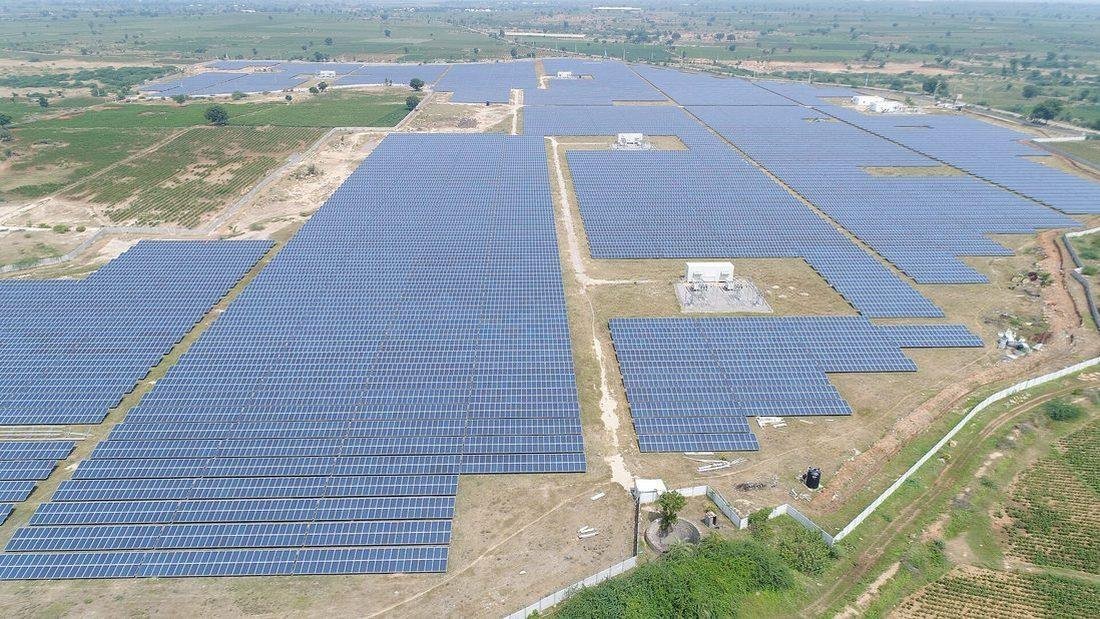
Image: Solar Power Plant Telangana II in state of Telangana, India, 12-MWp DCb by Thomas Lloyd Group, CC BY-SA 4.0, via Wikimedia Commons.
Most people buying rooftop solar in Raipur think carefully about panels and inverters, and barely at all about the meter. That is backwards. CSPDCL net metering for solar is what converts your daytime generation into value at night, and a system without it loses a large part of its economics.
A normal electricity meter counts in one direction. A bidirectional net meter counts separately in both.
During the day your panels supply your home first. Anything left over flows out to the CSPDCL network and the export register increments. At night, or on a dull monsoon afternoon, you draw from the grid and the import register increments. At billing, the two are netted.
So a household importing 480 units and exporting 390 units in a month is billed for 90 units plus fixed charges, rather than 480. That is the mechanism behind the savings figures in our solar savings guide.
Without the net meter, exported surplus simply flows into the network and you receive nothing for it - while still paying full price for everything you import after sunset.
An application is filed against your CSPDCL consumer number, naming the proposed capacity and the empanelled vendor. For residential systems this runs through the national PM Surya Ghar portal, which links the subsidy and net-metering processes together. Same-day once documents are in hand.
CSPDCL checks whether your distribution transformer can absorb the proposed export, and whether the requested capacity sits within your sanctioned load. Typically 7 to 15 days in Raipur.
This is the stage that occasionally returns a reduced capacity. In dense colonies where many rooftops have already gone solar, a transformer can reach its absorption limit.
Only after feasibility approval should the array go up. Installing first and applying later risks rejection. On-site work takes three to five days for a home, as set out in our installation timeline guide.
A CSPDCL engineer inspects the completed installation, verifying earthing, protection devices and - critically - the anti-islanding function that shuts the inverter down during a grid outage so linemen are not working on a line your panels are energising. Usually 7 to 10 days after completion is notified.
The bidirectional meter is fitted and sealed, and your connection is formally converted to a net-metered one. Generally 2 to 4 weeks, governed mostly by meter stock at your division office.
The commissioning certificate is uploaded, which for residential consumers also triggers the subsidy claim. PM Surya Ghar money reaches your bank account by DBT roughly 30 to 45 days later - see our subsidy and EMI guide.
| Stage | Typical Duration | Who Handles It |
|---|---|---|
| Registration | 1 day | Installer |
| Feasibility approval | 7 - 15 days | CSPDCL |
| Installation | 3 - 5 days | Installer |
| Inspection | 7 - 10 days | CSPDCL |
| Net meter fitted | 2 - 4 weeks | CSPDCL |
| Subsidy credited | 30 - 45 days after meter | Government DBT |
| Application to generation | 4 - 7 weeks |
Two constraints govern how much you can install.
Sanctioned load. Approved capacity is generally limited to your sanctioned load. A home sanctioned at 3 kW cannot normally net-meter a 10 kW array without first applying to raise the sanctioned load, which changes your fixed charges.
Transformer capacity. Cumulative solar on a distribution transformer is capped as a share of its rating. Where a colony has adopted solar heavily, new applications may be reduced or deferred.
There is also a commercial constraint. Because unused credits are settled or lapse at the end of the settlement year, a system generating far more than you consume returns little on that excess. Sizing close to actual annual consumption is the efficient choice for most households.
Read your first two or three bills carefully. They should show separate import and export figures and a net billed quantity. If export is reading zero while your monitoring app shows generation, something is wrong - usually a meter configuration issue - and it should be raised with CSPDCL straight away rather than at year end.
Keep the commissioning certificate, net-meter sealing record and subsidy sanction together. You will want them if you ever sell the property, since a commissioned net-metered system transfers with it.
A bidirectional meter replaces your existing meter and records electricity in both directions. Surplus solar exported during the day is credited against units you import at night, so you are billed only on the net difference.
Typically 2 to 4 weeks after the application and inspection, depending on meter availability at your division office. Feasibility approval before that usually takes another 7 to 15 days.
Generally up to your sanctioned load, subject to your local distribution transformer having spare capacity. If you want a larger array you can apply to increase your sanctioned load first.
Credits carry forward month to month within the settlement year. At the end of that year any unused surplus is settled or lapses according to the prevailing tariff order, which is why oversizing well beyond your consumption rarely pays.
No. Net metering is a condition of the subsidy. The claim is processed only after the bidirectional meter is commissioned and the commissioning report is uploaded.
Net metering is the difference between a solar system that halves your bill and one that nearly eliminates it. It is also the stage where do-it-yourself applications most often stall. We file it for every customer as part of the installation, not as an extra.
Visit us at C-29, Sector 3, Devendra Nagar, Raipur, Chhattisgarh 492001, call 083051 31420, or send us your details online. Our team answers every enquiry from Raipur and across Chhattisgarh, usually on the same working day.
Registration, feasibility, inspection coordination and commissioning report - handled end to end for every system we install.