
0%
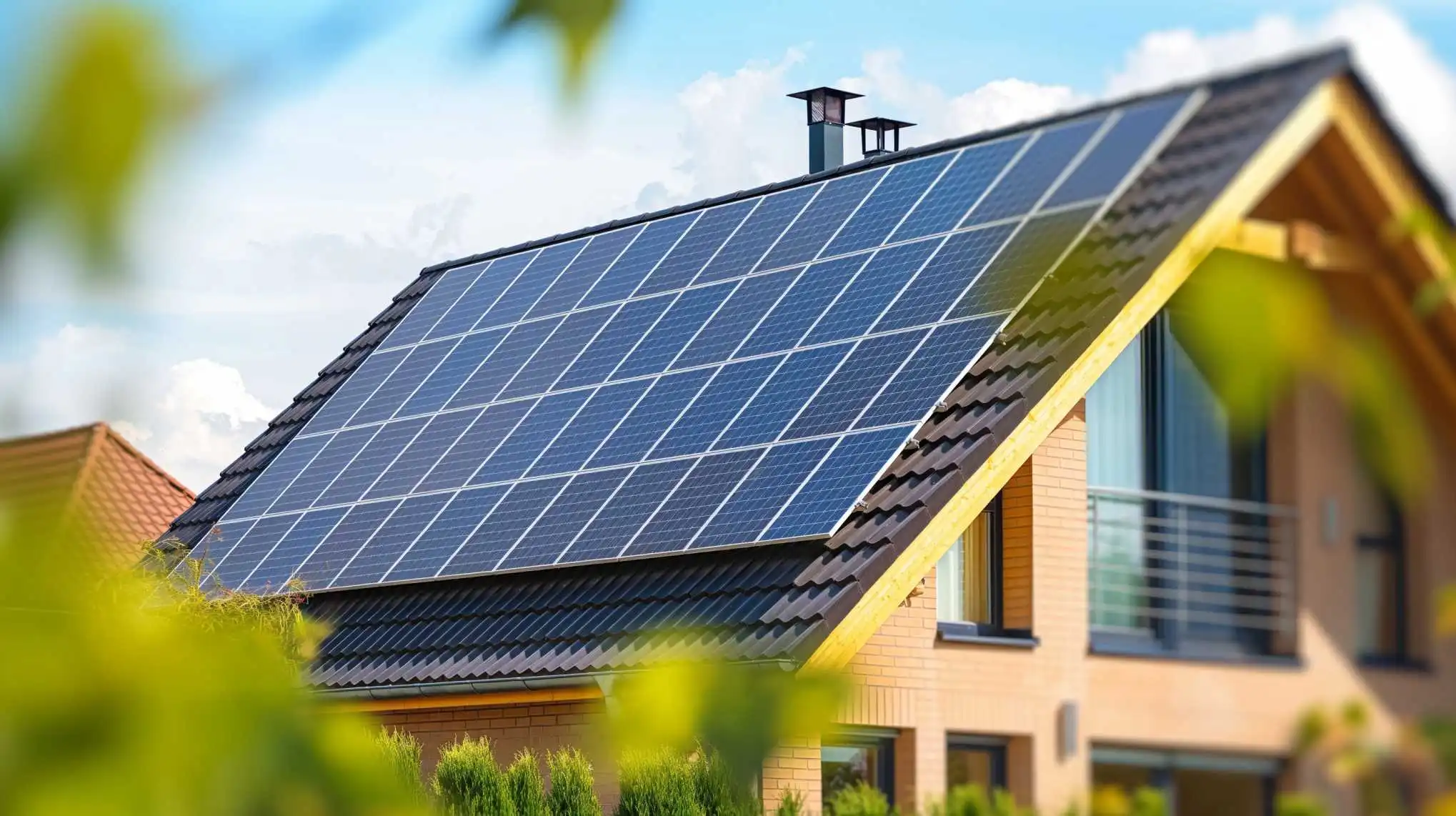
No private roof? Housing societies can still go solar and claim Rs 18,000 per kW for common facilities under PM Surya Ghar.
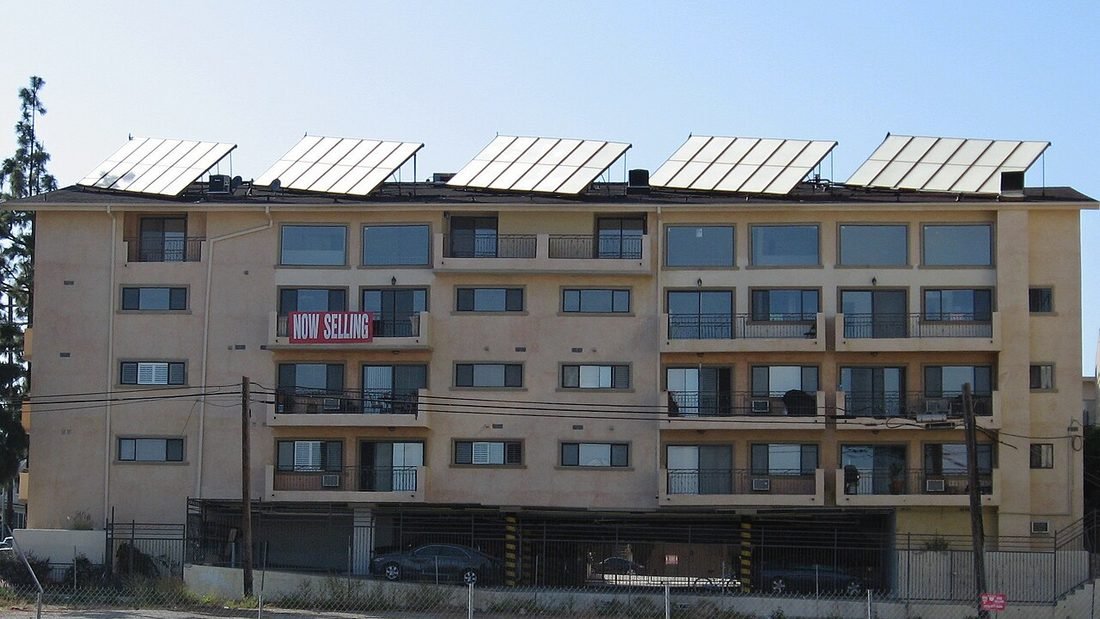
Image: Building with solar panels by Downtowngal, CC BY-SA 3.0, via Wikimedia Commons.
Most solar articles assume a house with a roof and an owner. Yet a large share of Raipur lives in apartments and gated societies where nobody owns the terrace alone. The good news is that solar for apartments and housing societies in Raipur is not only possible, it has its own subsidy under PM Surya Ghar, and common loads like lifts and water pumps are exactly the kind that solar suits.
Quick answer: a housing society or RWA can claim Rs 18,000 per kW on solar for common facilities, up to 500 kW. The society passes a general-body resolution, gets a roof and load survey, applies on the portal and commissions through CSPDCL. Payback on common loads is often about three to five years.
The PM Surya Ghar scheme includes a specific provision for group housing societies and resident welfare associations. It supports solar for common facilities, including EV charging, at Rs 18,000 per kW, with the capacity calculated at up to 3 kW per house and capped at 500 kW per society. Individual homes get Rs 30,000 per kW for the first 2 kW and Rs 18,000 for the third; societies get the flat Rs 18,000 per kW on common-area capacity.
| Item | Individual home | Housing society or RWA |
|---|---|---|
| Subsidy per kW | Rs 30,000 (first 2 kW), Rs 18,000 (third kW) | Rs 18,000 |
| Cap | Rs 78,000 at 3 kW | Up to 500 kW of common capacity |
| What it powers | The home's own meter | Lifts, pumps, lighting, EV charging |
| Who applies | The consumer | The society or RWA |
In most Raipur apartment buildings the terrace is a common area. Installing solar on it needs a general-body resolution, ideally with a clear vote count recorded in the minutes. Some societies allot roof sections to willing owners through a formal agreement. A written agreement avoids disputes years later, when someone sells a flat or a building needs waterproofing.
These loads run through the day, often at a commercial tariff, so most of what the system generates is consumed on site. That is why society payback is strong.
| Line item | Indicative figure |
|---|---|
| System cost, tier-1 equipment | Rs 7.5 - 8.3 lakh |
| RWA subsidy at Rs 18,000 per kW | - Rs 2.7 lakh |
| Net cost to the society | Rs 4.8 - 5.6 lakh |
| Annual generation | About 22,500 units |
| Annual saving (varies with tariff slab) | Rs 1.8 - 2.2 lakh |
| Payback | About 2.5 - 3.5 years |
These are indicative numbers for planning. Your own figures depend on the society's tariff category, actual common load and roof area, which a survey will pin down. Commercial-style economics are covered in our commercial solar installation in Raipur guide.
A society typically has several meters: one for common areas and one per flat. A rooftop system tied to the common-area meter and netted against common consumption is the simplest arrangement. National electricity rules also provide for virtual and group net metering, which let generation be shared across meters. Whether and how CSPDCL implements them in Chhattisgarh should be confirmed before you design around them. Our CSPDCL net metering guide covers the standard process.
| Objection | A fair response |
|---|---|
| "Why should my maintenance fee pay for this?" | Common-area electricity costs are paid by all residents; solar reduces them. Present the savings and net cost clearly. |
| "The roof will leak." | Ask for a waterproofing plan and a workmanship warranty that covers roof leaks caused by installation. |
| "What if the company disappears?" | Choose an installer with a verifiable local office and track record, and keep an annual maintenance contract. |
| "Will it spoil the building's look?" | Panels sit on the terrace behind the parapet; a survey can show visibility from the street. |
| "Nobody understands the subsidy." | Share a one-page summary: Rs 18,000 per kW for common facilities, up to the cap, applied for by the society. |
Appoint a committee member as the point of contact, keep the commissioning report and warranty documents in the society office and agree an annual maintenance contract so cleaning and inspection happen on a schedule. Review the inverter data every quarter against the original generation estimate and raise any shortfall with the installer promptly.
The subsidy provision for societies also supports EV charging as a common facility. If residents already own or plan to buy electric vehicles, ask the installer to size the system with charger load in mind and to specify the point of connection and metering clearly, so charging costs can be allocated fairly.
| Stage | Typical duration | Note |
|---|---|---|
| Committee discussion and bill collection | 1 - 3 weeks | Depends on meeting schedule |
| Survey, design and quotation | 1 - 2 weeks | Faster if roof drawings are available |
| General-body approval | 1 - 4 weeks | Needs notice and quorum |
| Portal application and CSPDCL feasibility | 2 - 4 weeks | Varies by division office |
| Installation | About 1 - 2 weeks | Depends on capacity |
| Net meter, inspection and subsidy | 1 - 3 months | Confirm current processing times |
Societies usually pass the savings on by lowering the common electricity component of the maintenance charge, funding repairs or building a sinking fund. Whatever the choice, record it in the resolution so residents know what to expect and the committee has a clear mandate. Where individual owners fund part of the system in return for a share of generation, a written agreement avoids disputes if the flat is sold. Seek legal and accounting advice on any arrangement that treats generation as income or allocates it to named owners.
Common loads such as lifts, pumps and corridor lighting run for long hours and are metered together, so the same panel capacity avoids more purchased electricity than the same capacity would on a single flat. A shared plant also benefits from scale: one design, one structure, one maintenance contract and one point of contact. Individual flat owners get the savings indirectly through lower common charges, while the society gets a visible long-term asset that adds to the building's appeal.
For societies that are unsure, a short survey and a one-page proposal costs nothing and gives the committee real numbers to discuss, instead of guesses.
For an overview of the scheme, read PM Surya Ghar Yojana in Chhattisgarh. If your society wants a quote, we are a solar company in Raipur that handles surveys, applications and installation end to end.
Yes, under the group housing society and resident welfare association provision. The scheme supports solar for common facilities, including EV charging, at Rs 18,000 per kW, up to 500 kW in total (calculated at 3 kW per house).
In most societies the terrace is a common area owned collectively. A general-body resolution authorises solar on it, and some societies allocate roof sections to individual owners by agreement.
Lifts, water pumps, corridor and basement lighting, club-house power and EV chargers. These common loads run through the day and are usually billed at a commercial rate, so self-consumption and savings are high.
Only if they have exclusive roof rights. Otherwise the practical option is a shared system for common loads. Virtual or group net metering is provided for in national rules, but ask CSPDCL what is permitted in Chhattisgarh today.
Plan on one to two months for approvals and survey, then a week or two on site depending on size, plus CSPDCL metering and inspection.
We prepare the proposal, the general-body presentation and the application for housing societies and RWAs across Raipur. Visit C-29, Sector 3, Devendra Nagar, Raipur, Chhattisgarh 492001, call 083051 31420 or request a society survey. See our commercial solar solutions page.
Free roof survey, common-load analysis, subsidy calculation and a clear presentation for your general body.