
0%

The cheapest way to improve a solar system's performance is also the one most owners skip for months at a time.
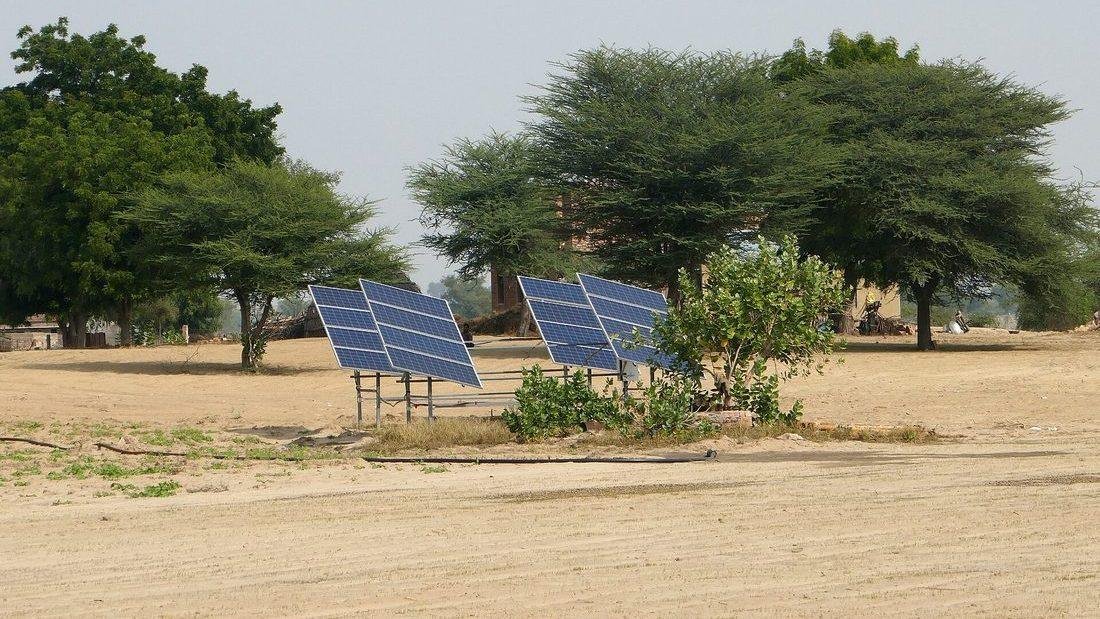
Image: Panneaux solaires dans le désert du Thar (Rajasthan) by Ji-Elle, CC BY-SA 4.0, via Wikimedia Commons.
A customer in Tatibandh called us convinced his six-month-old system was faulty. Generation was down almost a quarter. There was no fault. There was a layer of construction dust from the plot next door, and a cleaning cycle he had not started because nobody had told him to.
Twenty minutes of work restored the output. Solar panel cleaning in Raipur is the least glamorous and highest-return maintenance task there is.
Three local factors combine.
A long dry season. From October to June there is very little rain to wash panels. That is eight to nine months of uninterrupted accumulation - precisely the months when irradiance is highest and losses hurt most.
Construction and road dust. Raipur has been building continuously for a decade. Fine cement and earth dust travels, settles and bonds to glass, particularly with morning dew.
Agricultural and industrial particulate. Field dust drifts in from surrounding districts during ploughing, and anything near the Urla or Siltara belt - or Korba's thermal corridor - collects heavier deposits still.
| Condition | Output Loss | Monthly Loss on 3 kW | Monthly Loss on 10 kW |
|---|---|---|---|
| Clean panels | 0% | Rs 0 | Rs 0 |
| Light dust, 2 - 3 weeks | 5 - 8% | Rs 140 - 240 | Rs 480 - 800 |
| Moderate, 1 - 2 months | 12 - 18% | Rs 350 - 540 | Rs 1,150 - 1,800 |
| Heavy, 3+ months | 20 - 30% | Rs 600 - 900 | Rs 2,000 - 3,000 |
| Bird droppings on cells | Localised, severe | Varies | Varies |
Bird droppings deserve separate mention. Uniform dust reduces output proportionally, but an opaque spot on a single cell forces that cell to behave as a resistance rather than a generator. It can drag down the whole string and create a hotspot that damages the panel over time. Remove them promptly.
Early morning or after sunset. Never at midday - panel surfaces reach well over 60 degrees in a Raipur summer, and cold water on hot glass risks thermal shock and cracked cells.
| Period | Conditions | Cleaning Frequency |
|---|---|---|
| October - November | Post-monsoon, dust returning | Every 3 - 4 weeks |
| December - February | Dry, cool, excellent generation | Every 3 weeks |
| March - May | Peak dust, dust storms | Every 2 weeks |
| June | Pre-monsoon storms | Every 2 - 3 weeks, and after storms |
| July - September | Monsoon, rain cleans | Monthly inspection only |
Generation will fall during the monsoon. That is normal and was accounted for in your annual estimate.
Panels produce 30 to 50 per cent of peak on heavily overcast days, and occasionally less during a sustained downpour. Raipur receives around 1,200 mm across three to four months. Meanwhile March, April and October are excellent, and December and January are better than many people expect because cool air improves panel efficiency.
Judge your system annually, not monthly. If the twelve-month total lands near the design estimate, it is working correctly.
Five minutes a week is enough.
We carry out performance reviews and cleaning across Raipur, including for systems other companies installed. The wider maintenance routine, AMC scope and pricing are in our warranty and maintenance guide.
Every two to four weeks from October to June, and after any dust storm. During the July to September monsoon, rain does most of the work and a monthly check is enough.
Typically 15 to 25 per cent in Raipur conditions, and more near construction sites, unpaved roads or industrial areas. On a 3 kW system that can mean several hundred rupees a month quietly lost.
Plain water with a soft brush or squeegee, early morning or evening. Never spray cold water on hot panels at midday, never use detergent or abrasive pads, and never use a high-pressure jet - all of these damage the anti-reflective coating or risk cracking cells.
Yes, at 30 to 50 per cent of peak on heavily overcast days. Raipur's monsoon lasts three to four months and the remaining eight to nine months of strong sun more than compensate, so judge performance annually rather than monthly.
Compare this week's generation in your monitoring app against the same week a month earlier. A gradual 15 to 20 per cent decline with no weather explanation is almost always soiling. A sudden drop in one string is usually an electrical fault instead.
Nothing else you can do for a solar system returns as much for as little. Twenty minutes with a soft brush and a bucket, every three weeks through the dry season, is worth more than any equipment upgrade you could buy.
Visit us at C-29, Sector 3, Devendra Nagar, Raipur, Chhattisgarh 492001, call 083051 31420, or send us your details online. Our team answers every enquiry from Raipur and across Chhattisgarh, usually on the same working day.
Scheduled cleaning, performance review and electrical inspection across Raipur - including systems installed by other companies.