
0%
What the scheme pays, who qualifies, what Chhattisgarh adds on top and where the national rollout stands in October 2026.
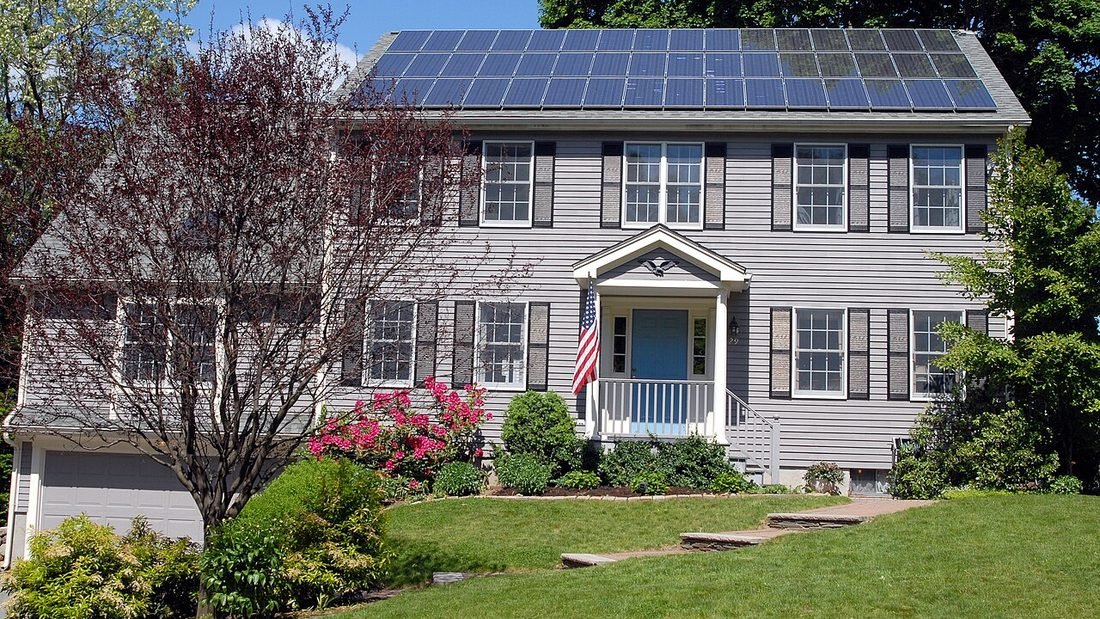
Image: Solar panels on house roof by Gray Watson User:E090, CC BY-SA 3.0, via Wikimedia Commons.
Of every question we hear in the showroom on Devendra Nagar, the most common is simply this: what does PM Surya Ghar Yojana in Chhattisgarh actually pay, and is the state adding anything? This guide answers both with current numbers, flags the places where sources disagree and sets out the application path for a CSPDCL household.
Quick answer: the central subsidy is up to Rs 78,000 for a 3 kW rooftop system, the scheme targets up to 300 free units a month, and Chhattisgarh has announced an extra state subsidy of up to Rs 30,000 for larger systems. Applications are filed online and the money is credited to your bank account.
PM Surya Ghar: Muft Bijli Yojana was launched in February 2024 to put rooftop solar on one crore households. In an August 2026 reply in the Lok Sabha, the government said more than 50 lakh households had benefited, with subsidy worth over Rs 28,000 crore released and the scheme's budget raised from Rs 17,000 crore in 2025-26 to Rs 22,000 crore in 2026-27. Industry coverage has also reported a record 3.16 lakh installations in a single month (May 2026). Different news sites quote different running totals, so treat any single number as approximate and check the portal for the latest.
The Ministry of New and Renewable Energy has also said it plans to add battery storage options for homes and to expand the Model Solar Village programme. If you are thinking about backup, read our note on solar battery storage for homes in Raipur.
| System size | Central subsidy | Typical monthly use it suits |
|---|---|---|
| 1 kW | Rs 30,000 | Up to about 150 units (1 - 2 kW range) |
| 2 kW | Rs 60,000 | 150 - 300 units (2 - 3 kW range) |
| 3 kW and above | Rs 78,000 (maximum) | Above 300 units |
The subsidy stops growing at 3 kW. Larger homes can install more capacity, but the extra kilowatts are unsubsidised. That is why 3 kW is the most common choice for a Raipur home, and why our 3 kW solar system price guide uses it as the standard example.
In 2025 the state cabinet approved an additional subsidy for domestic consumers, in addition to the central support. As reported at the announcement, it was Rs 15,000 for a 1 kW system and Rs 30,000 for 3 kW and above, which brought the combined support on a 3 kW system to Rs 1,08,000. CSPDCL receives the grant in advance and disburses it to beneficiaries, and the state indicated targets of 60,000 plants in 2025-26 and 70,000 in 2026-27.
State schemes get revised, and online sources even disagree on the slabs. Before you sign, ask for the state benefit to be written into your quotation with the date of the order it relies on.
| Line item (3 kW, tier-1 equipment) | Amount |
|---|---|
| System cost | Rs 1.65 - 1.90 lakh |
| Central subsidy | - Rs 78,000 |
| State top-up, if applicable | - up to Rs 30,000 |
| Net cost to you | Rs 57,000 - 82,000 |
| Annual bill saving | Rs 29,000 - 36,000 |
| Payback with both subsidies | About 2 - 3 years |
The sequence is: register on the portal with your consumer number, apply for the capacity you want, pick a registered vendor in your district, get CSPDCL feasibility approval, install, get the net meter fitted, pass inspection, upload bank details and receive the subsidy. We have written the full walkthrough, with a timeline and a list of reasons applications stall, in our guide to solar subsidy apply online in Chhattisgarh.
Free does not mean your meter reads zero. A 3 kW system in Raipur generates about 4.0 to 4.5 units per kW per day on average, roughly 360 to 400 units a month. Through net metering, units you export are credited against units you draw, so a typical household sees its bill fall by 70 to 90 per cent and often pays only the fixed charges. It is the generation, not a government credit, that does the work, and it keeps doing it for 25 years.
The subsidy is capped at 3 kW, so the benefit per rupee spent is highest for households whose consumption fits within 3 kW. Using the slabs published for the scheme, the sizing logic looks like this:
| Monthly consumption | System capacity | Central subsidy | Comment |
|---|---|---|---|
| Up to about 150 units | 1 - 2 kW | Rs 30,000 - 60,000 | Small households; full subsidy per kW on the first two kilowatts |
| About 150 - 300 units | 2 - 3 kW | Rs 60,000 - 78,000 | Typical Raipur family home |
| Above 300 units | 3 kW and more | Rs 78,000 (maximum) | Consider a bigger system, with the extra capacity unsubsidised |
A household using 500 units a month can still choose 5 kW to cover the whole bill. The subsidy stays at Rs 78,000, and the extra two kilowatts pay back through the bill rather than through the subsidy. Whether that is the right trade depends on your roof, budget and tariff slab, which is why we size from twelve months of bills.
The scheme has been accompanied by collateral-free, low-interest loans for residential systems up to 3 kW through participating banks. Sources quote the interest rate at about 6.75 to 7 per cent and a loan ceiling of around Rs 2 lakh, but bank terms change, so ask the branch for the current rate and documents. Since the central subsidy arrives after commissioning, many households use a loan to bridge the gap and then repay a chunk when the subsidy is credited. Our subsidy and EMI guide explains the options.
In the first billing cycle after net metering is active, you will see exported units credited against imported ones. Do not judge the system by a single month. Generation varies between peak spring months and the monsoon, so compare your bill over a full year with the previous year. Ask your vendor to show you how to read the inverter app, and keep the commissioning report, invoices and warranty documents together. For the cleaning routine that protects output, read our solar panel cleaning guide.
If you are comparing providers, our checklist for the best solar installer in Raipur covers the ten questions that matter, and our solar in Chhattisgarh guide covers the wider state picture.
The central subsidy is Rs 30,000 per kW for the first 2 kW and Rs 18,000 for the third kW, capped at Rs 78,000 for 3 kW and above. Chhattisgarh announced an additional state top-up for domestic consumers, reported at Rs 15,000 for 1 kW and up to Rs 30,000 for larger systems. Confirm the current state order with CSPDCL.
Any Indian household with a valid CSPDCL residential electricity connection, a roof suitable for solar and no earlier central rooftop solar subsidy on that connection can apply. You need legal occupancy of the roof and a bank account for the subsidy.
The scheme's headline benefit is up to 300 units a month of free electricity. A correctly sized 3 kW system in Raipur generates roughly 360 to 400 units a month, so most of an average family's consumption is covered, and surplus is credited through net metering.
Tenants without roof rights cannot. Residents of housing societies can benefit through the group housing and resident welfare association provision, which supports solar for common facilities. See our guide for apartments and housing societies in Raipur.
Yes. Applications, vendor selection and subsidy tracking run through pmsuryaghar.gov.in. You can do it yourself or have a registered vendor manage it on your behalf, but the application stays in your name.
Send us your last CSPDCL bill and we will size the system, calculate the central and state subsidy for your connection and file the application. Visit C-29, Sector 3, Devendra Nagar, Raipur, Chhattisgarh 492001, call 083051 31420 or request a callback. See our full PM Surya Ghar Yojana in Raipur page for the subsidy slabs.
Free eligibility check and subsidy calculation for your CSPDCL connection, from a PM Surya Ghar registered vendor in Raipur.