
0%

Batteries are the next big conversation in rooftop solar. Here is when they pay off in Raipur, what they cost and how to size one.
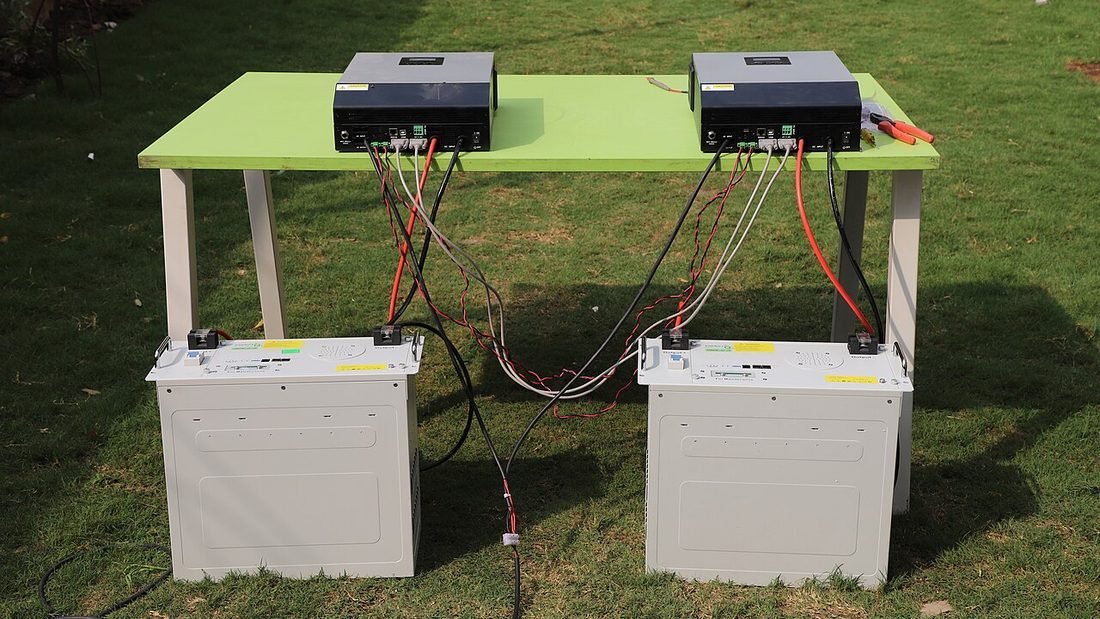
Image: Inverter battery - Loom Solar by Pihu5432, CC BY-SA 4.0, via Wikimedia Commons.
Two years ago, battery storage was a niche add-on. In 2026 it is a mainstream question: the ministry has said it intends to add battery storage to the residential programme, and homeowners are asking whether to buy one now. The honest answer for most homes in the city is that solar battery storage for home in Raipur is a backup decision, not a savings decision. This guide helps you decide.
Quick answer: a battery does not cut your bill further. It keeps your fans, lights, Wi-Fi and fridge running when the grid fails. If your feeder is stable, skip it. If outages are frequent, a right-sized lithium battery is worth the premium of roughly Rs 1.5 to 2.5 lakh.
A grid-tied rooftop system switches off during an outage so that it cannot feed a dead line and endanger a CSPDCL lineman. A hybrid system adds a battery and a hybrid inverter that isolates your home from the grid and runs your chosen circuits from stored power. Your monthly saving is broadly the same either way, which is why battery economics should be judged like insurance.
| Your situation | Battery? | Why |
|---|---|---|
| Stable supply, outages under an hour a month | Usually no | On-grid gives the lowest cost and the subsidy |
| Outer colony with frequent multi-hour cuts | Yes | Backup has real daily value |
| Work from home, online classes | Yes | Downtime has a cost |
| Medical equipment at home | Yes | Safety, not savings |
| Shop that loses sales in a cut | Often yes | Compare with a generator's fuel and noise |
| Tight budget, mainly want lower bills | No | Spend on more solar capacity instead |
| Factor | Lithium (LFP) | Tubular lead-acid |
|---|---|---|
| Usable capacity | About 90% | About 50% |
| Expected life in Raipur | 10 - 15 years | 3 - 5 years |
| Maintenance | None | Quarterly electrolyte checks |
| Heat tolerance | Good with ventilation | Life drops sharply in heat |
| Upfront cost per kWh | Higher | Lower |
| Cost per usable kWh over life | Lower | Higher |
Lead-acid often looks cheaper on day one and costs more by year six because you will have replaced it at least once. If you buy lithium, choose a reputable manufacturer with a documented battery management system and a written warranty stating years and cycles.
Start with what must stay on during an outage, not with a battery size.
| Appliance | Typical draw | Energy over 4 hours |
|---|---|---|
| 8 LED lights | 80 W | 0.32 kWh |
| 4 ceiling fans | 240 W | 0.96 kWh |
| Refrigerator | 150 W average | 0.60 kWh |
| TV and Wi-Fi | 120 W | 0.48 kWh |
| Essentials total | 590 W | 2.36 kWh |
| 1.5 ton inverter AC (optional) | 1,100 W | 4.40 kWh |
A 5 kWh lithium battery covers essentials for most of an evening. Add air conditioning and the same battery empties in two to three hours, so decide honestly whether the AC belongs on the backed-up circuit. For a fuller walkthrough, see our hybrid solar system for home in Raipur guide.
| Configuration | Storage | Indicative total cost | Backup of essentials |
|---|---|---|---|
| 3 kW hybrid | 5 kWh lithium | Rs 2.8 - 3.6 lakh | 5 - 6 hours |
| 5 kW hybrid | 10 kWh lithium | Rs 4.2 - 5.5 lakh | 10 - 12 hours |
| 5 kW hybrid | 10 kWh lead-acid | Rs 3.4 - 4.2 lakh | 5 - 6 hours usable |
| 3 kW on-grid (no battery) | None | Rs 1.65 - 1.90 lakh | None during outage |
The central subsidy under PM Surya Ghar is linked to the grid-connected rooftop solar capacity, not to the battery. The ministry has said it plans to bring battery storage into the programme, but until the rules are published and tested, treat the battery as an unsubsidised cost. Ask your installer how your configuration will be handled on the portal, and read the PM Surya Ghar Yojana in Chhattisgarh guide for the current slabs.
If you expect to add a battery later, choose a hybrid-ready inverter now and keep a clean, labelled essential-loads board. The extra cost today is small, and it avoids replacing the inverter later. Our on-grid vs off-grid vs hybrid guide compares the three options in detail.
The key design decision is which circuits are on the backed-up board. Putting everything on it needs a large battery. Choosing lights, fans, fridge and Wi-Fi keeps the battery small and the backup long.
Install the battery in a ventilated, shaded, dry spot away from flammable material. Use the cable sizes and protective devices recommended by the battery and inverter makers, and keep the installation accessible for inspection. Lithium batteries need no topping up, but you should check the display or app for fault warnings, keep the area clean and have a technician inspect connections annually. Lead-acid banks need regular electrolyte checks and terminal cleaning.
Look beyond the headline years. A good warranty states the number of cycles, the minimum capacity retained at the end of the warranty period, the operating temperature range and what counts as normal use. Ask who honours the warranty locally: the manufacturer, an importer or your installer. Raipur summers push temperatures high, so confirm the battery is rated for them.
| If this is you | Consider |
|---|---|
| Rare outages, tight budget | On-grid only, with a small UPS for the router |
| Frequent evening outages | Hybrid with a 5 kWh lithium battery for essentials |
| Work-from-home or medical needs | Hybrid sized for longer backup and a clean essential-loads board |
| Want flexibility to add storage later | Hybrid-ready inverter now, battery later |
Battery costs have been falling globally, and the ministry has said it plans to bring storage into the residential programme. If and when that happens, the details of any support will be published on the official portal. Until then, plan on the basis of what you can verify today, and design your system so a battery can be added without replacing the inverter.
If your main worry is keeping the router and a few lights on for a couple of hours, a conventional inverter and small battery you already own, or a compact UPS for the Wi-Fi router, may cover the need for a fraction of the cost of a hybrid battery system. Pair it with a grid-tied solar system for the savings. This two-part approach is often the best value for households whose outages are short and occasional. Reserve a full hybrid battery system for situations where outages are long, frequent or critical.
Looking for equipment details? See our solar inverter and battery solutions, or the broader guide to solar in Raipur.
Not usually. A plain on-grid system is cheaper, subsidised and low-maintenance, but it switches off during a power cut. Add a battery only if outages on your feeder are frequent or long, or you work from home or run medical equipment.
A 5 kWh lithium battery with a hybrid inverter on a 3 kW system typically brings the whole system to Rs 2.8 to 3.6 lakh. A 10 kWh lithium setup on 5 kW is about Rs 4.2 to 5.5 lakh. Compare that with Rs 1.65 to 1.90 lakh for 3 kW on-grid.
Lithium iron phosphate (LFP) tolerates heat better, gives about 90 per cent usable capacity and lasts 10 to 15 years. Tubular lead-acid costs less upfront but gives about 50 per cent usable capacity and 3 to 5 years in Raipur summers.
The central subsidy is tied to grid-connected rooftop solar capacity, not to the battery. The ministry has said it plans to integrate battery storage into the scheme, but confirm with your vendor how a hybrid configuration is treated on the portal today.
Yes, if the inverter is hybrid-ready or you choose a compatible battery-ready inverter at the start. Retrofitting later costs more than planning for it, so tell your installer early.
We size batteries from the loads you actually need during a cut, not from a brochure. Visit C-29, Sector 3, Devendra Nagar, Raipur, Chhattisgarh 492001, call 083051 31420 or book a survey. See our solar inverter and battery solutions and hybrid solar system pages.
Load-based battery sizing, lithium or tubular options and clear costs, from a Raipur team that installs hybrid and on-grid systems.