
0%

Three configurations, three very different price tags, and one question that decides between them.
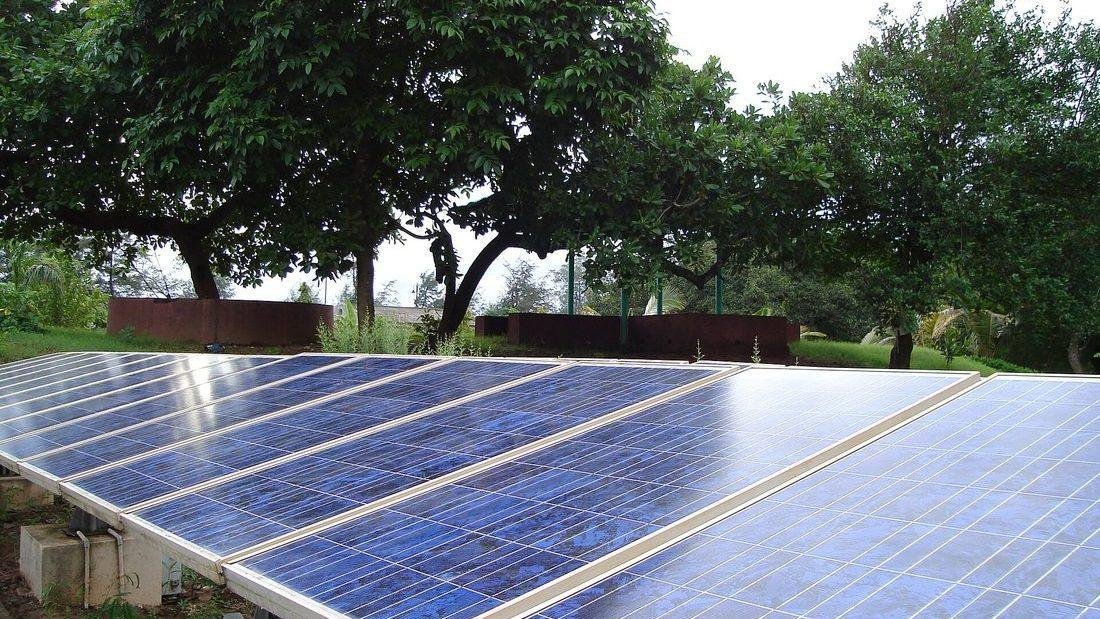
Image: Solar panels at the Goa Science Centre, Miramar, circa 2006 4 by Fredericknoronha, CC BY-SA 4.0, via Wikimedia Commons.
Nearly every solar enquiry we take in Raipur arrives with the same underlying confusion. People have been quoted three different system types at three wildly different prices and cannot tell what they are actually choosing between.
The distinction is simpler than it looks, and it comes down to one question: what should happen when the grid goes down?
Before you type solar installer near me into a search box and start collecting quotes, settle this question. It decides your budget more than any other choice, because the three configurations differ in price by lakhs for the same generating capacity.
Panels, an inverter and a bidirectional net meter. Generation powers your home first, surplus exports to CSPDCL for credit, and at night you draw those credits back. No batteries.
During an outage it shuts down. Not a fault - a legal requirement, so your panels cannot energise a line a lineman is working on.
Cheapest per unit generated, and the only residential configuration eligible for the full PM Surya Ghar subsidy.
Panels, a charge controller and a battery bank, with no grid connection at all. Everything you generate is either used immediately or stored.
Complete independence, but you pay for it twice: once for a battery bank large enough to carry you through the night and a cloudy day, and again in lost subsidy, because no net metering means no PM Surya Ghar claim.
Panels, a hybrid inverter, a battery bank and a grid connection. It behaves like an on-grid system day to day, exporting surplus, but during an outage it islands your home and runs backed-up circuits from the battery.
Covered in depth in our hybrid solar guide.
| Factor | On-Grid | Off-Grid | Hybrid |
|---|---|---|---|
| Cost (5 kW) | Rs 2.6 - 3.0 lakh | Rs 4.5 - 6.0 lakh | Rs 4.2 - 5.5 lakh |
| Batteries | None | Large bank required | Moderate bank |
| Works during outage | No | Yes | Yes |
| PM Surya Ghar subsidy | Yes, up to Rs 78,000 | No | Solar portion only |
| Net metering | Yes | No | Yes |
| Maintenance burden | Lowest | Highest | Moderate |
| Replacement cost over 25 yrs | Inverter once | Batteries 2-5 times | Batteries 1-2 times |
| Best for | Most Raipur homes | Remote farms, no grid | Frequent or long outages |
Work through these in order.
Is there a reliable CSPDCL connection at the property?
If no - remote farmland, forest property, an unconnected site - you are choosing off-grid. There is no decision to make.
If yes, continue.
How often does supply actually fail, and for how long?
Be specific rather than impressionistic. Check a month of evenings. Most of central Raipur - Devendra Nagar, Shankar Nagar, Telibandha, Pandri - now sees short, infrequent cuts. Outer colonies and semi-urban areas see more.
If outages are rare or brief: buy on-grid. It is the cheapest, simplest, best-subsidised option, and adding storage to solve a problem you do not have is expensive.
Do you already own an inverter and battery?
Many Raipur homes do. Pair an existing inverter with a new on-grid solar system and you have covered generation and backup separately, usually for less than a hybrid costs.
If outages are frequent or long, or downtime has a real cost - medical equipment, a home office, a shop - buy hybrid, and size the battery to essential loads rather than the whole house.
The purchase price understates the difference, because batteries are consumables and panels are not.
Across twenty-five years, an on-grid system will typically need one inverter replacement. A hybrid with lithium storage will need one or two battery replacements. An off-grid system with lead-acid could need the bank replaced five times.
That is the real reason we steer most Raipur households towards on-grid: not the quotation, but what the system costs to keep running until 2051.
Configuration and capacity are independent decisions. Choosing on-grid does not tell you whether you need 3 kW or 6 kW - that comes from twelve months of CSPDCL bills, your sanctioned load and available shadow-free roof area.
Note that net-metered capacity is generally limited to your sanctioned load, as explained in our net metering guide. Costs by size are in our savings and price guide.
Commercial premises usually go on-grid for the same reasons, with two exceptions: operations that cannot tolerate downtime, such as cold storage or hospitals, and units where a diesel generator already carries the outage load and solar is purely about cost. Our commercial solar guide covers the business case.
For most Raipur homes, an on-grid system - it is the cheapest per unit generated, the only residential type eligible for the PM Surya Ghar subsidy, and needs no batteries. Choose hybrid only if outages on your feeder are frequent or long.
By design and by regulation. A grid-tied inverter must shut down when the grid fails, so it cannot energise a line that CSPDCL linemen may be working on. This anti-islanding function is checked during inspection and cannot be disabled.
Rarely. Off-grid means paying for a large battery bank and losing subsidy eligibility, to solve a problem the Raipur grid largely does not have. It makes sense for remote farms, forest properties and locations without a reliable connection.
Only if you install a hybrid-ready inverter from the start. A standard grid-tied string inverter cannot usually be retrofitted with storage, so you would need to replace it or add a separate AC-coupled battery unit.
Off-grid systems do not, because net metering is a condition of the scheme. A hybrid can qualify on its solar generation portion if it is net-metered and installed by an empanelled vendor, but the battery is never subsidised.
Most Raipur households are best served by a plain on-grid system, and a good installer will say so rather than upselling storage. Batteries are for people with a specific backup problem, not a default upgrade. Answer the outage question honestly and the choice makes itself.
Visit us at C-29, Sector 3, Devendra Nagar, Raipur, Chhattisgarh 492001, call 083051 31420, or send us your details online. Our team answers every enquiry from Raipur and across Chhattisgarh, usually on the same working day.
Tell us your bill, your outage frequency and what must stay running during a cut. We will recommend the cheapest option that genuinely meets it.